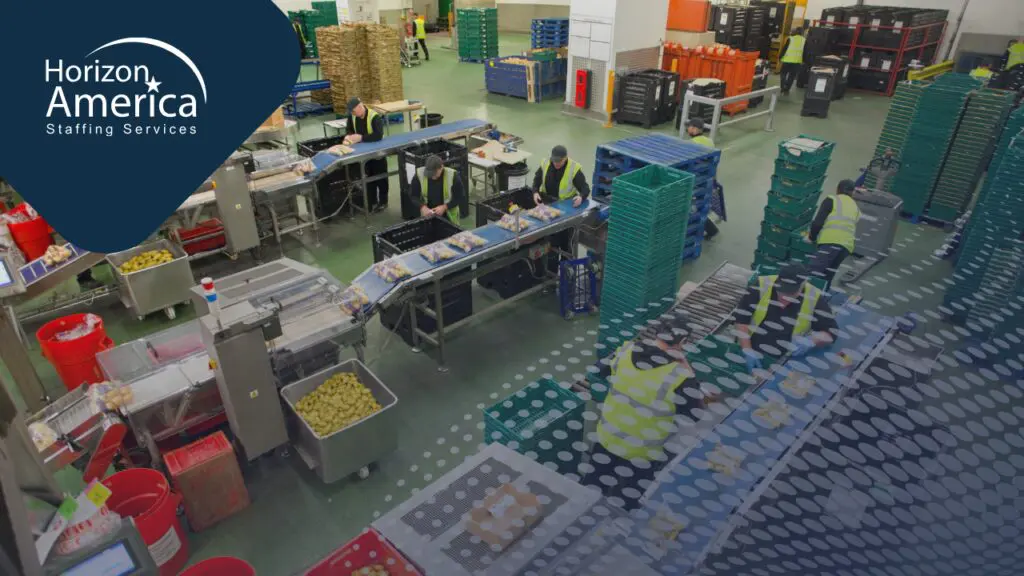
Distribution staffing lessons often reveal workforce challenges that extend beyond hiring alone. Food manufacturing and distribution may operate in different environments, but they often encounter a similar workforce challenge: labor shortages can be symptoms of a deeper operational issue.
In food manufacturing, production schedules, product mix, and strict quality requirements can create labor imbalances that are difficult to solve by simply increasing headcount. Distribution operations experience a comparable challenge, although it often appears in the form of fluctuating order volumes, changing fulfillment priorities, and shifting customer demand. When those operational signals are misread, organizations can mistake a labor mismatch for a staffing shortage.
According to Deloitte’s 2025 manufacturing trends analysis, nearly 60 percent of manufacturers identified attracting and retaining employees as their top business challenge. At the same time, Deloitte and The Manufacturing Institute estimate that 1.9 million manufacturing jobs could remain unfilled over the next decade if workforce issues are not addressed.¹ When workforce challenges extend beyond hiring, they require organizations to rethink how labor is planned and deployed.
Understanding these distribution lessons can help operations leaders focus on improving workforce planning instead of continually chasing more hires.
Recognizing the Signs of a Labor Mismatch in Distribution
If the labor model no longer matches operational demand, hiring more people can temporarily ease pressure without resolving the underlying workforce issue. Before expanding headcount, distribution leaders should examine how labor is being deployed across their operation.
1. Coverage Gaps Persist Despite Strong Hiring
A healthy recruiting pipeline should improve coverage. If open positions are consistently filled but overtime remains high, fulfillment delays continue, or supervisors are constantly reallocating employees, the issue may extend beyond recruiting.
Much like food manufacturing labor mismatch, distribution operations can experience labor imbalances where workers are available but not aligned with the areas experiencing the greatest demand. Continually hiring without addressing the underlying workforce model can become an expensive cycle.
In food manufacturing, this same pattern appears when facilities keep hiring for a line that’s struggling — only to find the problem was scheduling structure or onboarding depth, not candidate supply.
2. Demand Volatility Creates the Wrong Staffing Decisions
Distribution demand doesn’t remain consistent. Seasonal peaks, promotional campaigns, supplier disruptions, and changing customer purchasing patterns all affect staffing requirements.
Treating every surge as a hiring problem often results in excess labor during slower periods and insufficient coverage during unexpected spikes. Effective staffing requires organizations to understand when fluctuations are temporary and when they represent lasting operational changes.
Rather than reacting to every change in volume, workforce planning should adapt to evolving operational conditions.
3. Throughput Becomes the Better Performance Indicator
Open positions tell only part of the story. Distribution leaders gain a clearer picture by evaluating how labor supports operational outcomes such as throughput, order accuracy, dock flow, and fulfillment speed. These indicators often reveal whether staffing levels, scheduling practices, and workforce allocation are aligned with actual business demand.

Applying Diagnostic Staffing to Improve Distribution Performance
Before expanding headcount, distribution organizations benefit from the same disciplined approach food manufacturers apply: reviewing operational conditions first, then deciding whether additional labor is the right response.
1. Evaluate Workforce Allocation Before Expanding Headcount
A staffing review should consider more than vacancy numbers. Leaders should assess questions such as:
- Which shifts experience the greatest operational strain?
- Where do fulfillment bottlenecks consistently occur?
- Which functions rely heavily on overtime?
- Are experienced employees concentrated in only certain areas?
This broader evaluation reflects how many manufacturers are approaching workforce planning today. Deloitte’s 2025 Smart Manufacturing and Operations Survey found that 68 percent of manufacturers are hiring new talent while 40 percent also use contingent labor to strengthen workforce capability, recognizing that effective staffing involves balancing multiple workforce strategies rather than relying on hiring alone.²
2. Compare Staffing Plans Against Operational Demand
Staffing plans should reflect how work actually moves through the facility rather than relying on historical averages alone.
Changes in customer expectations, order profiles, product volumes, or shipping schedules may require adjustments to workforce deployment. A labor model that worked last year may no longer support current operational realities.
This is one of the most valuable distribution staffing lessons organizations can apply from food manufacturing: workforce planning should evolve alongside business conditions.
Read more: What Food Manufacturing and Distribution Workers Have in Common
3. Build Staffing Decisions Around Operational Data
Diagnostic staffing connects workforce planning with operational performance instead of treating recruiting as a separate function.
By reviewing fill rates alongside throughput, scheduling trends, attendance patterns, and production or fulfillment demands, organizations gain a more complete understanding of why staffing challenges occur. This broader perspective helps reduce recurring labor shortages caused by operational misalignment rather than recruiting limitations.
Read more: Staffing Metrics: How to Measure Year-End Success
Stop treating a workforce model problem like a recruiting problem.
Labor shortages can sometimes reflect a workforce model that no longer matches operational demand.
When staffing decisions are based on operational diagnostics instead of assumptions, organizations are better positioned to improve coverage, increase throughput, and respond more effectively to changing demand.
If your operation continues experiencing staffing challenges despite ongoing hiring efforts, it may be time to look beyond headcount alone.
Horizon America works with distribution operations to diagnose workforce model problems before recommending staffing solutions — so the next hire is the right one, not just another replacement. Talk to a Horizon America recruiter about what’s driving your fill-rate challenges.
References
- Schlotterbeck, Michael et al. “2025 Deloitte Manufacturing Trends: From a Workday Lens.” Deloitte, 21 Jul. 2025, https://www.deloitte.com/global/en/alliances/workday/perspectives/deloitte-manufacturing-trends-from-a-workday-lens.html
- Gaus, Tim and Schlotterbeck, Michael. “2025 Smart Manufacturing and Operations Survey: Navigating challenges to implementation.” Deloitte, 1 May. 2025, https://www.deloitte.com/us/en/insights/industry/manufacturing-industrial-products/2025-smart-manufacturing-survey.html