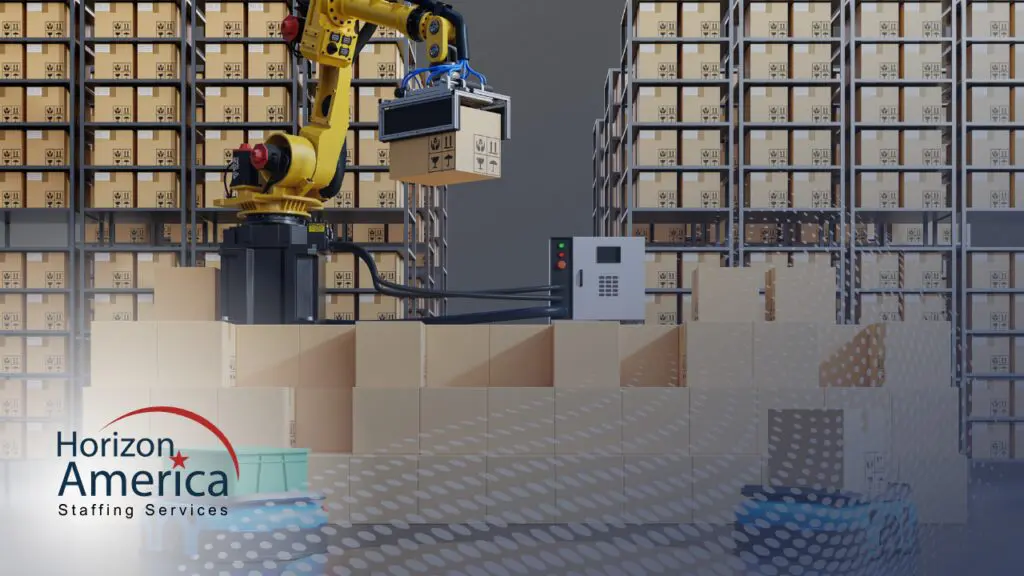
Warehouse automation in staffing is accelerating across U.S. distribution networks. Facilities are rapidly adopting robotics-assisted picking, automated storage and retrieval systems. Real-time inventory platforms are quickly becoming standard inside modern facilities. For operations leaders, automation promises higher throughput and improved accuracy.
Technology, however, does not operate independently. Workforce readiness determines whether automation delivers measurable returns. Staffing for warehouse automation requires planning that aligns hiring, safety, and training with system implementation.
Deloitte notes that warehouse automation improves picking accuracy and operational scalability, particularly during demand surges.¹ Automation strengthens performance when employees are prepared to work within automated environments.
Automation Reshapes Roles Inside Automated Distribution Centers
As automation expands, physical strain may decrease in some areas, but oversight responsibility increases. Employees are expected to monitor robotic workflows, manage system exceptions, and coordinate between automated and manual zones.
A recent industry survey reported that 98 percent of warehouse workers say automation makes them more productive.² This reinforces that workers are not resisting automation when it improves workflow. They can adapt when the environment supports them.
However, the shift naturally does require new hiring considerations. Speed and physical endurance remain relevant, but automated distribution centers also require:
- Comfort using digital dashboards and handheld systems
- Awareness of safety protocols in human-robot environments
- Ability to troubleshoot system alerts calmly and efficiently
Warehouse robotics staffing must assess adaptability alongside traditional warehouse experience. As automation increases system accuracy, workforce precision must increase with it.
Staffing for Automation Must Align with Implementation Phases
Automation investments often move faster than workforce preparation. When staffing alignment lags behind system rollout, the operational friction increases.
Structured staffing for automation should begin before deployment.
Hiring profiles, onboarding frameworks, and supervisory expectations should reflect the environment employees are entering. Clear alignment during implementation reduces disruption. Employees understand their responsibilities earlier, and supervisors reinforce expectations consistently. This helps the system performance to stabilize faster.
Automation is most effective when workforce preparation mirrors the discipline of the rollout plan.
Redesign Roles with Clear Accountability
As automation integrates into operations, job descriptions should reflect new responsibilities. Exception handling, preventive observation, and escalation protocols must be clearly defined.
When roles are intentionally redesigned, employees understand how they contribute to system performance. Without clarity, automation can create confusion instead of efficiency.
Recruit for Automation-Ready Workers
Automation-ready workers are not engineers. They are employees who demonstrate learning agility, comfort with evolving workflows, and consistent safety discipline.
Screening for these qualities reduces disruption during transition phases. It also strengthens long-term retention as facilities continue integrating light industrial technology.
Read more: Streamline Industrial Preselection
Safety and Upskilling Drive Retention in Automated Environments
Automation changes workflow patterns, and safety protocols must evolve accordingly. Robotics and autonomous systems operate on programmed paths, but human interaction remains constant. Clear coordination procedures and reinforced training reduce uncertainty in shared environments.
Continuous Training Reinforces System Stability
Upskilling is not optional in automated facilities. As responsibilities shift from repetitive manual tasks to monitoring and coordination, employees require structured development. According to SHRM, advancing AI is creating new needs for deskless workers to reskill while also opening up new career pathways in industries ranging from manufacturing to security.³
Technical literacy, system troubleshooting fundamentals, and cross-training between manual and automated zones strengthen operational resilience.
Training should not be treated as a one-time onboarding step. Reinforcement following system updates, refresher sessions on safety procedures, and ongoing skill development help maintain performance consistency. Structured upskilling ensures automation strengthens operations rather than destabilizing them.
The Operational Risks of Misaligned Warehouse Automation in Staffing
When workforce readiness does not match automation deployment, performance gaps appear quickly. Downtime increases, minor issues escalate, and turnover rises when roles feel undefined or unstable.
Automation systems are engineered for reliability and precision. Staffing strategy must reflect that same consistency. Operational discipline requires workforce calibration. Organizations that treat automation as both a technology initiative and a workforce initiative see stronger long-term results.
Aligning Staffing with Automation
Successful automation requires more than equipment installation. It requires workforce alignment at every stage of implementation. Organizations that treat automation as both an operational and workforce initiative reduce disruption and protect long-term ROI.
Conduct a Workforce Capability Audit
Alignment begins with visibility. Before implementation phases accelerate, organizations should assess existing workforce capabilities. Evaluate how well supervisors understand escalation protocols and exception handling.
Integrate Staffing into Rollout Timelines
Automation deployment typically follows structured phases: installation, testing, calibration, and full production. Staffing transitions should mirror those phases.
Bringing in automation-ready employees too late increases strain on existing teams. Hiring too early without structured training can create disengagement. Strategic workforce planning aligns hiring velocity with system readiness, maintaining operational balance throughout the rollout.
Invest in Automation-Specific Onboarding
Onboarding in automated environments must go beyond general warehouse orientation. Employees should receive structured training on:
- Human-machine coordination procedures
- System alert interpretation and escalation paths
- Safety expectations within robotic zones
- Cross-functional workflow between automated and manual areas
Reinforcing these elements early builds confidence and reduces error rates during critical stabilization periods. Clear onboarding ensures employees understand how their responsibilities contribute directly to system reliability.
Read more: Onboard for Retention
Staff your sustainable automation workforce with Horizon America.
Horizon America understands the workforce demands of automated distribution centers and evolving light industrial tech environments. If your operation is investing in automation or expanding automated workflows, contact Horizon America today to build a staffing strategy aligned with your technology goals.
References
- “Five in 5: Warehouse automation.” Deloitte, https://www.deloitte.com/us/en/services/consulting/articles/improving-efficiency-through-warehouse-automation.html 25 Jan. 2026
- “Nearly Half of Warehouse Workers Receive Raises Because of Warehouse Automation.” PR Newswire, 13 Nov. 2025, https://www.prnewswire.com/news-releases/nearly-half-of-warehouse-workers-receive-raises-because-of-warehouse-automation-302613866.html
- Zielinski, Dave. “How AI Is Transforming Deskless Jobs, Skills, and Career Paths.” SHRM, 1 Apr. 2025, https://www.shrm.org/enterprise-solutions/insights/how-ai-is-transforming-deskless-jobs-skills-career-paths