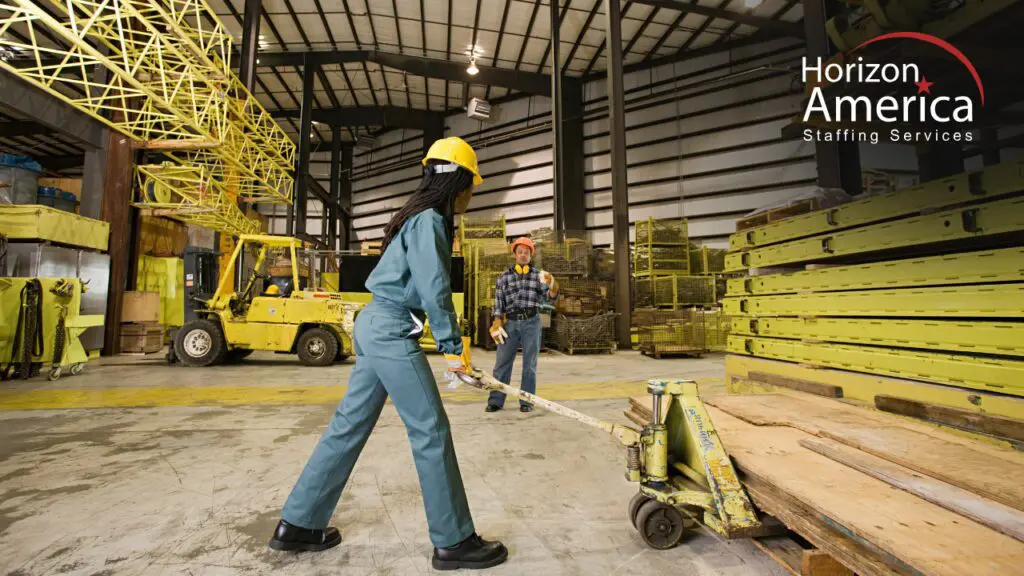
In distribution centers today, order volumes shift faster, customer expectations are tighter, and automation continues to change how work gets done on the floor. Employment in the warehousing and storage sector has grown steadily in recent years.¹ Distribution networks are under increasing pressure to scale quickly, and workforce strategies are evolving to keep pace.
This is where hybrid staffing models become more relevant. By combining temporary, temp-to-hire, and direct hire approaches, employers can create a structure that supports both short-term demand and long-term performance. Instead of relying on a single hiring method, the focus shifts to aligning each role with the right staffing strategy.
What Hybrid Staffing Models Actually Look Like in Practice
At a high level, hybrid staffing blends multiple hiring approaches into a single workforce strategy. But in a distribution center environment, this is highly operational.
Most facilities already have a mix of roles with different levels of predictability and responsibility. A hybrid approach simply formalizes how those roles are staffed.
For example:
- Temporary workers support peak demand, seasonal spikes, or short-term surges
- Temp-to-hire roles allow employers to evaluate performance before making a long-term commitment
- Direct hires anchor the operation in critical, high-impact positions
In practice, this creates a layered workforce. Some roles are designed for flexibility, while others are structured for consistency. Not every position benefits from the same hiring approach. For example, entry-level picking and packing roles require speed and scalability, while equipment operators or team leads require stability and experience.
The goal is not to replace one model with another, but to use each where it makes the most sense.
The Operational Benefits of a Hybrid Approach
Hybrid staffing models are often discussed in terms of flexibility, but the real value shows in day-to-day operations. When structured correctly, this approach supports both efficiency and resilience.
Better control over labor costs
Labor costs come from wages and are also influenced by overtime, turnover, and hiring inefficiencies. A hybrid model helps balance these factors.
Temporary staffing can absorb fluctuations in demand without overextending the core team. At the same time, direct hires reduce the constant need for retraining and onboarding. This balance helps employers avoid the cycle of overstaffing during slow periods and scrambling during peak periods.
The cost of getting this wrong can be significant. Replacing an employee can cost anywhere from 50 to 200 percent of their salary, making turnover a major driver of operational expense.²
Improved productivity on the floor
Consistency plays a major role in output. When too many roles are filled with short-term labor, productivity can dip due to constant retraining. On the other hand, relying only on permanent staff can limit flexibility during high-volume periods.
A hybrid structure creates a middle ground. Core roles remain stable, while flexible roles absorb variability. This allows teams to maintain momentum even as workloads change.
Stronger workforce stability over time
Workforce stability means having the right structure in place to handle change. Temp-to-hire roles are especially useful here. They give employers time to assess reliability, performance, and fit before extending a permanent offer. Over time, this leads to better hiring decisions and more cohesive teams.
Better alignment between role and employee also contributes to engagement. Highly engaged teams are shown to be more productive and profitable, reinforcing the value of thoughtful hiring strategies.³
Building a Hybrid Workforce That Actually Works
A hybrid model is not something that can be applied as a template. It needs to reflect the specific demands of your operation.
1. Start with role segmentation.
Break down your workforce by function. Identify which roles require consistency and which can handle variability. This creates a foundation for assigning the right staffing type to each position.
2. Map demand patterns.
Look at historical data to understand when demand rises and falls. This helps determine how much flexibility you actually need, rather than relying on assumptions.
3. Standardize onboarding.
Ensure that all workers, regardless of hiring type, receive consistent training and expectations. This reduces variability in performance and supports safer operations.
4. Review and adjust regularly.
Hybrid staffing is not static. As automation, order volumes, and customer expectations change, your staffing mix should evolve as well.
How Hybrid Staffing Supports a More Flexible Workforce Strategy
The broader goal of hybrid staffing models is to create flexible workforce solutions that don’t compromise reliability. A purely flexible workforce can struggle with consistency. A purely fixed workforce can struggle with adaptability. Hybrid staffing bridges that gap by combining both elements into a single, structured approach.
Organizations that prioritize workforce agility are consistently better positioned to respond to change and maintain performance under shifting conditions.⁴ This makes hybrid staffing a hiring tactic, and part of a broader operational strategy.
Read more: Flexible Scheduling: The Future of Light Industrial Staffing
Build a hybrid staffing strategy with Horizon America.
Horizon America works with employers to develop staffing strategies that reflect real-world conditions.
If you’re evaluating your current approach to distribution center hiring or looking to build a more adaptable workforce, contact Horizon America today to explore what a hybrid staffing model could look like for your operation.
References
- “Table B-1. Employees on nonfarm payrolls by industry sector and selected industry detail.” Bureau of Labor Statistics, 6 Mar. 2026, https://www.bls.gov/news.release/empsit.t17.htm
- Dyerly, Regina. “The Myth of Replaceability: Preparing for the Loss of Key Employees.” SHRM, 21 Jan. 2025, https://www.shrm.org/executive-network/insights/myth-replaceability-preparing-loss-key-employees
- “The Benefits of Employee Engagement.” Gallup, 16 Feb. 2026, https://www.gallup.com/workplace/236441/employee-engagement-drives-growth.aspx
- Poynton, Shannon, et al. “Stagility: Creating stability for workers for organizations to move at speed.” Deloitte, 24 Mar. 2025, https://www.deloitte.com/us/en/insights/topics/talent/human-capital-trends/2025/organizational-agility-and-creating-stability-at-work.html